Kristian Vistrup Madsen on Thilo Heinzmann's practice
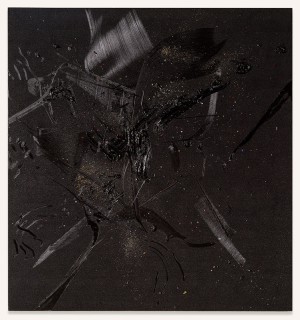
»O. T.«, 2025
Watch the video essay with this text.
Thilo Heinzmann is a German artist who has been working as a painter since the 1990s. Throughout his practice, he has applied a rare dedication to exploring his medium, what a painting can be, and how it can be made.
Heinzmann began his work as an assistant to Martin Kippenberger, and in a way it is tempting to see his work then as coming out of that 1980s generation around Kippenberger, where painting happens after the studio, so to speak, in the meeting with the audience and with the exhibition space. This is in many ways the legacy of Kippenberger.
But the more time I spend with Heinzmann's work, the more important it seems to me to understand his paintings really as paintings, as highly precise and intentional aesthetic encounters.
Heinzmann works in several diverse series, and something I find quite interesting about his practice is how it is in many ways teleological in the sense that you can see very clearly what steps he takes to develop his method and to develop these different series.
But then at the same time, there is a strong sense of simultaneity between them. He began in the 1990s with his Pigment Paintings while also painting on chipboard and experimenting with Styrofoam. All these things have been happening on and off with varying degrees of intensity alongside one another. The experience and knowledge he gains from one series feeds directly into his work on the others. So there is a sense that they are not sequential but that they cross-pollinate, always, in how they develop.
I would describe two tendencies in his work or, let's say, divide his work into two groups: One group is characterised by a search for essence by breaking form down into essential elements. This applies very clearly to the Pigment Paintings. White backgrounds with unmixed pigments almost tossed onto them in a dynamic gesture. This work reduces paint to a single tangible and visible element in the form of a pigment grain meeting the surface of the canvas.
This is essentially the same method that goes into the Chipboard Paintings. Chipboard, being made from tiny shredded pieces of wood mixed with glue, and Heinzmann breaks his material apart to find its constituent elements. These elements then become the subject of the painting while the intact chipboard functions as the ground. He then uses resin, which is not unlike the glue that holds the chipboard together, as the painterly gesture in those works.
It is easy to see then how mosaic and Styrofoam are more examples of materials that reveal their singular elements when broken apart. Across these bodies of work, Heinzmann plays with the difference between surface and part. The elements that make up a hole as well as what can sit on that surface as a motif or painterly gesture.
In the second group of works I would place the Tacmo and the Aicmo paintings.
The Tacmo paintings, Tacmo standing for speed or velocity, are black paintings made from thick layers of paint through which Heinzmann drags his fingers, making negative imprints. In contrast to the Pigment Paintings where elements are added, here we see form emerging through the taking away of matter but we also see how close those two things are, in a way.
Similarly, in the Aicmo paintings, aluminium boards are pierced by sharp tools, sometimes as thin slits and other times as holes, but always as this kind of manifestation of a concentration of energy - the imprint of force onto a material. So again there is this sense of that it is an absence that has actually produced the composition that we are looking at.
What is true for all of these works is that they are extremely sensual. They appeal directly to perception and even seem to sharpen perception. They ask us to be very sensitive and very alert to the beauty of the resin that acts as paint on the chipboard works for instance or to the sharpness of the edge in the Aicmo paintings.
The Tacmo paintings in particular are actually relatively few in number. Heinzmann has said that this is not because there are limited possibilities within that form but because, in a way, they are too pleasurable. There is a kind of pleasure in destruction or in this sort of illicit manoeuvre of running your fingers through wet paint that is almost too intense.
It is also important, I think, to note that none of this work is connotative in a cultural or allegorical sense. Black does not signify mourning or any other kind of affect, just as white does not signify purity or innocence. These are simply surfaces that create different conditions of visibility and sensual impression: Black absorbs light, white reflects it.
Black paintings also change enormously depending on distance and angle and lighting. They become dependent much more, or created much more, together with the viewer in how they move around them.
This is very true for the new group of paintings currently on view at neugerriemschneider. Heinzmann has called these Sand Paintings, like the Pigment Paintings named after the active ingredient, in a way.
Where pigment would largely disappear on a black surface, sand has this reflective quality similar to glass, which is also used both in the Pigment Paintings and in the Sand Paintings. The sand maintains itself against the black background rather than being swallowed by it. It catches the light. These works sit somewhere between the Tacmo paintings and the Pigment Paintings, almost as a fusion of the two.
They include more recent developments from the pigment paintings such as brush stroke and gesture, and the small shards of glass. They are also more carefully composed than some of the earlier works that are more reliant on chance and speed.
But at the same time, they retain this special tactile pleasure that we find in the Tacmo paintings, of physically moulding the surface at very close range.
To return briefly to context, another artist who was also an assistant to Kippenberger is Michael Krebber, whose painting has sometimes been described as “end-game,” a kind of countdown where very little seems left to do. There is something quite melancholic about that position, a feeling that options are running out or that beauty were no longer possible.
Another comparison might be to Michel Majerus, who also worked in the 1990s and was concerned with expanding painting into space, like onto skateboard ramps or architectural structures.
Looking to these artists helps clarify what is special about Heinzmann's practice; for unlike these approaches, his work is not melancholic, but affirmative; not exhaustive or expansive but concentrated. There is something very joyful and vitalistic about it, a great sense of energy that is contained within each painting.
In the last decade, painting has reemerged from out of the shadow of these post-conceptual strategies, as more openly devoted to beauty and pleasure and emotion. In many ways, Heinzmann's work aligns with this new turn, which even allows us to see it more clearly on aesthetic terms.
At the same time, what I think makes Heinzmann's work so relevant in this moment and as part of this new return to painting is that it retains some very important lessons from modernism, such as this attention to materiality and formal methodology. I think actually perhaps more so than these postmodern predecessors, some of the people that Heinzmann really looks to for inspiration are Emil Schumacher or Karl Otto Götz, who were working in the 1950s.
There is a kind of generosity in this approach in the way that Heinzmann shows us every single step that he takes. Every movement he makes is visible on the surface of the work, and, in a sense, it explains itself but without laying bare the secret of its contents, let's say.
I think in that way the work recalls this post-war modernist painting which had an almost scientific quality, like taking measured steps, testing possibilities and crucially also sharing the results - because science only works if its findings can be shared and Heinzmann's paintings operate in a similar way by being so open about their process. I think this is perhaps also something he's learned from his second teacher in Frankfurt, Thomas Bayrle.
But what we can call this kind of scientific approach is also what allows Heinzmann to transport inside his work highly personal, emotional and abstract content. In that sense I think that Heinzmann shows us not that painting is running out of options, but really how much there still is, how beauty can emerge from within the very structure of a material itself, from the intention of the artist and the attention that they ask of the viewer in return.